Test your Innovation IQ
-
Individual Creativity
Are you more of a creator or an innovator? -
Organisational Creativity
How innovative is your organization? -
Creative Leadership
Is your manager more of a visionary, luminary or mentor? -
Teamkreativität
How creatively adept is your team?
*
21 tests taken in the last 30 days
This free test shows you your company‘s creative and innovative potential.
IQudo Research on Creativity
Research projects at the Karlsruhe Institute of Technology (since 2012).
Creativity and Business Success >> Creative Dividend Study 2024
According to the IQudo Creativity Dividend Study*, creative companies more frequently achieve higher revenue growth and show significantly greater employer attractiveness. We were able to substantiate this correlation through research conducted at the Karlsruhe Institute of Technology (KIT). In total, 102 participants from companies in Germany took part in the IQudo study. Specifically, creative companies achieve sales growth of over 10 percent 3.1 times more often and growth of over 20 percent 4.5 times more often than non-creative companies.
* Walter, K.M.. (2024)
Dual Thinking (passion & empathy) >> research-based innovation method
In 2016, as part of a Master’s thesis*, we surveyed 155 engineers at the car manufacturer Mercedes-Benz about workplace creativity. According to the findings, passion is the main reason for resourcefulness at work. 55 percent of the Mercedes-Benz engineers surveyed identified „love for their profession“ as creativity-promoting. Based on the study, conducted at the Karlsruhe Institute of Technology, we developed the innovation method Dual Thinking. With Dual Thinking, developers seek a solution based on both their passion and the user’s needs. This dual approach combines intrinsic motivation and empathy.
* Kind, T. (2016)
Creativity and Time Pressure >> expert interviews
In 2002, Harvard Professor Teresa Amabile put forward the thesis that time pressure prevents creative thinking: „Quite simply, extremely high time pressure may engender cognitive strategies that allow no time to think creatively.“ On the other hand, there are always examples of individuals, teams, or companies that achieve creative solutions under enormous time pressure.
To investigate which factors influence creativity under time pressure, we conducted a qualitative study in 2022 in the form of semi-structured expert interviews.* We interviewed directors, creative directors, and editors about creativity under the gun. We wanted to know which factors have a positive or negative influence. The result of the expert survey: It’s possible to be creative under time pressure if certain conditions are met. Time pressure can even foster concentration and willingness to experiment. However, diverse, mutually inspiring teams, a culture of trust, and intrinsic motivation are crucial for developing creative solutions in high-pressure situations. More about Creativity and Time Pressure.
Creativity in the Office >> IQudo Ideation Studies
To determine where, when, and how the best ideas emerge, we’ve been conducting the IQudo Ideation Studies, since 2010. The initial study in Stuttgart (Germany) revealed that only 6.4 percent of respondents had their best ideas at work. By 2015, in San Francisco, with 502 participants from various industries, that figure had already risen to over 16 percent. Then, in 2016, at the car manufacturer Mercedes-Benz in Germany, over a third of the 155 engineers reported finding their best ideas in the office.
What’s particularly interesting is that not a single engineer attributed their brilliant ideas to office design. The factor of time also played a subordinate role, ranking second to last with just ten percent of mentions. This is even more surprising given that all respondents faced significant time pressure.
The three main parameters that foster inventiveness in the office include passion for the job, inspiring colleagues, and creativity demanded by management.

Why most ideation workshops fail?
50 factors the IQCI Analysis considers for an idea to succeed.
Developing ideas for products is much more complex than putting colorful post-its on a whiteboard. Actually, having a great idea is just the beginning! Even the most brilliant idea can end up in the bin without a resilient visionary tirelessly championing it; without a diverse team to develop it to roll-out; without a courageous CEO providing fresh capital; and without a corporate culture that demands out-of-the-box thinking.
The IQCI Analysis evaluates 50 factors across four levels, ensuring idea workshops are not just inspiring, but also profitable.
IQudo Research on Creativity
Research projects at the Karlsruhe Institute of Technology (since 2012).
Levels
Sub-levels
Factors
Items
10 Reasons to Measure Creativity
Understand Creativity
Translate Creativity into Data
Measuring KPIs is crucial. But how to measure creativity? The IQCI analysis transforms business creativity into data—structured across four levels, ten sub-levels, 50 factors, and 70 items resulting in one IQCI-Score.
Optimize Team Collaboration
Understanding each employee’s creativity profile and distinguishing between Creators and Innovators enables the ideal formation of complementary innovation teams.
Dismantle Innovation Barriers
The IQCI analysis pinpoints how the team, management, or company culture either supports or impedes creative processes, offering clear starting points for improvement.
Boost Employee Engagement
Systematically analyzing creativity and innovation sends a powerful message to high-potentials: their creative input is truly valued.
Understand Creativity
Using the IQCI analysis, you can create customized training programs that more precisely target and develop the innovation potential of employees, teams, and management.
Monitor Creativity Initiatives
Measuring the Innovation IQ before and after training interventions helps to demonstrate the success of investments in fostering creativity.
Minimize Risk
The IQCI score indicates the company’s innovation capability. This can help minimize risk in developing new ideas and allow for timely optimization measures.
Increase Revenue Growth
The IQudo Creative Dividend study found that creative companies achieve 10 percent or greater revenue growth 3.1 times more frequently. The IQCI analysis delivers the data for optimizing business creativity.
Boost Employee Engagement
Companies that systematically cultivate creativity boost their attractiveness as employers. The IQudo Creative Dividend study found that creative companies receive national awards 2.9 times more often than non-creative companies.
The key to innovation is not knowledge, but understanding.
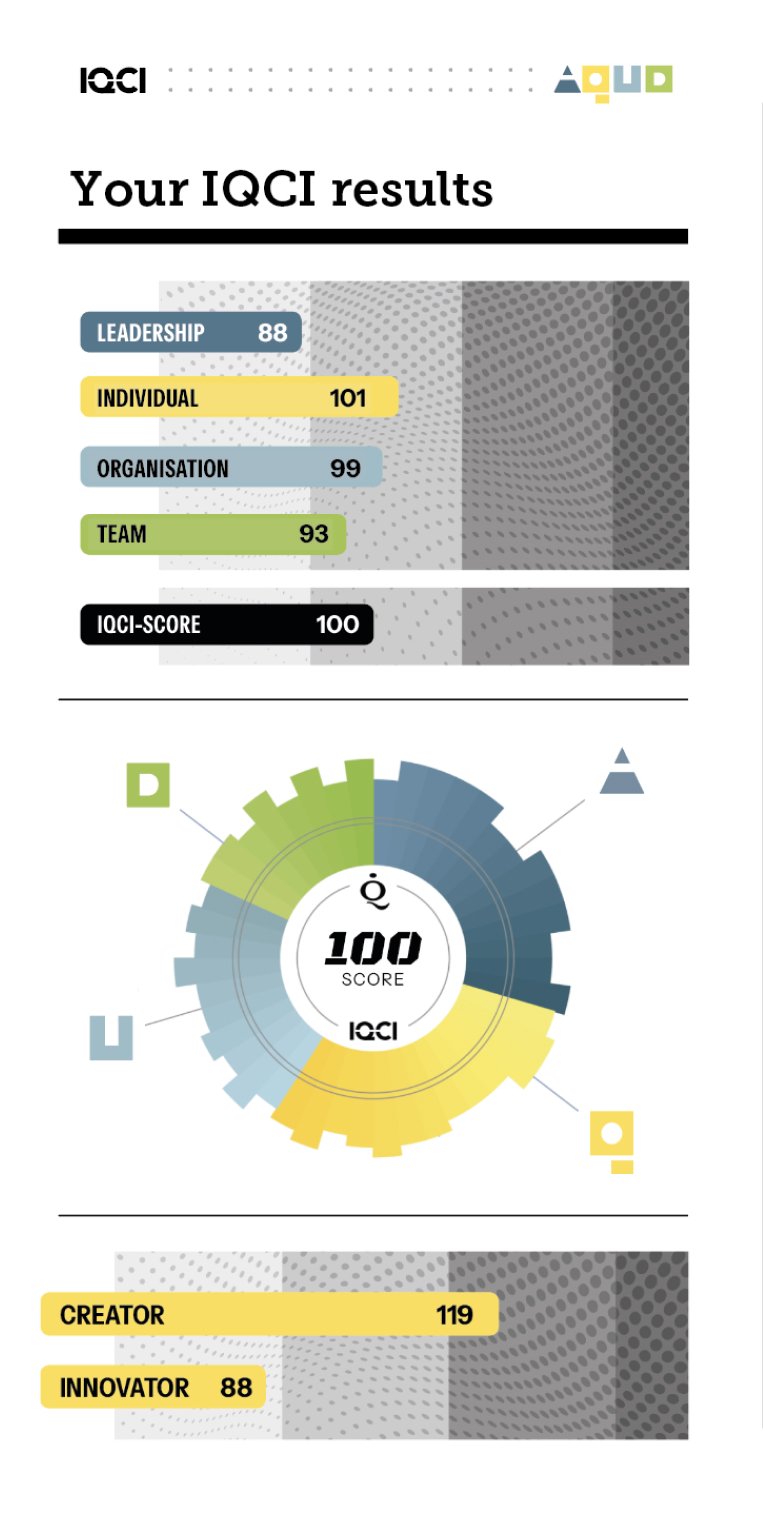
Key Results of the IQCI Analysis
Leadership
Individual
Organisation
Team
How to get your Innovation-IQ
IQpedia
Find answers to your questions.
FAQ on Corporate Creativity
What is corporate creativity?
Defining creativity in a business context has been attempted in academia for over 70 years, without a universally accepted definition. Today, the definition from Harvard University, which classifies corporate creativity as original and useful, has largely become established. However, following Runco and Jaeger (2012, p.92), we define corporate creativity as the production of original and effective ideas. Why?
- 1. Original: A creative idea should be unique and stand out significantly from existing ideas.
- 2. Effective: A creative idea doesn’t have to be immediately useful but must be effective. Effectiveness goes beyond mere usefulness. An idea can be creative even if it has no practical utility, for example, through aesthetic or emotional impact. For instance, the design of a new shoe in the fashion industry might not necessarily be useful, as it might not offer functional improvements over existing models, but it can still be considered creative.
We only refer to an idea as creative when both the criteria of originality and effectiveness are present.
How do creativity and innovation differ?
The word „innovation“ originates from the Latin verb „innovare“ („to renew,“ „to make new“). The concept of innovation was established by the Austrian Joseph Schumpeter (1883-1950). In his works, particularly „The Theory of Economic Development“ (1911/1934), the economist defined innovation as the „implementation of new combinations,“ thereby laying the theoretical foundation for our current understanding of innovation. Schumpeter distinguished between invention (the purely technical side of a novelty) and innovation (the economic and social implementation of an invention in the market).
However, today’s scientific work underscores the central role of creativity in the innovation process. „Creativity“ originally comes from the Latin word „creare,“ meaning „to create,“ „to give birth to,“ or „to create anew.“ Therefore, creativity encompasses the development of original and effective ideas at the beginning and during new development, while innovation is the successful implementation of creative ideas and focuses on economic impact. As John Doerr wisely put it, „Ideas are easy. Execution is everything.“ This highlights that while creativity sparks the initial concepts, it’s the diligent and effective execution that truly brings innovation to fruition and makes a tangible difference in the market.
Why do we distinguish between creator and innovator?
The development and implementation of ideas into a market-ready innovation involve different skill sets. While originality, willingness to experiment, curiosity, or intuition are required for idea development, entrepreneurial thinking, persuasiveness, or perseverance are demanded for idea implementation. These character strengths are rarely fully combined in one person. Therefore, we categorize individuals into two types: the Creator and the Innovator. This classification should not be understood as an either/or, but rather as a weighting of abilities. Elements of a Creator and an Innovator are present in each of us in varying degrees. The division serves to raise awareness of strengths and areas for improvement in the creative process and to enable better compilation of innovation teams.
Can the best ideas originate in the workplace?
Yes and no. In 2010, the first IQudo Idea Generation study in Stuttgart revealed that only 6.4% of respondents had their best ideas at work. In the follow-up studies in New York and San Francisco in 2015, this figure rose to 14% and 16.7% respectively, among 500 respondents in each city. By 2016, the third IQudo study at Daimler-Benz showed that over 37% of the 152 engineers had their best ideas at work. The four most frequently cited reasons for creativity were:
- Passion for the job
- Inspiring colleagues
- Required creativity
- Freedom of action
Time and office space design played no role for the job-creative Mercedes-Benz engineers. They ranked second to last and last, respectively, with under 10% and 0% of mentions.
On the other hand, the „job-uncreative“ respondents cited the following reasons for their lack of ideas at work:
- Stress/no time
- Too many distractions
- Office design
- Creativity is not required
The role of office design in workplace creativity
Office design seems to be overrated, at least when it comes to creativity. According to the IQudo Ideation Studies conducted in New York and San Francisco (2015), each with 500 professionals, the design of the rooms played a subordinate role in fostering inventiveness. In another IQudo study at Daimler AG (2016) in Germany, office design even landed in last place, with zero percent of mentions. What’s more important is „freedom of behavior,“ which was mentioned by 17 percent of the 155 Mercedes-Benz engineers.
What does „freedom of behavior“ mean?
Every company has a code of conduct. This includes, among other things, respectful interaction with colleagues. Employees regulate extreme emotions to stay within the behavioral corridor and avoid disturbing colleagues in their tightly scheduled work processes. Through this code, individuals give up a part of their authenticity and, with it, a part of their autonomous needs. Autonomy is closely intertwined with a natural urge to explore. Creative people are curious and have a strong desire to understand things. To develop ideas, creative thinkers look in different directions. This can also mean someone gazing dreamily out the window for ten minutes. But what kind of looks would they then receive from colleagues? Which brings us back to freedom of behavior. It’s not so much about how the space is designed, but what is allowed within those spaces. A sofa, after all, invites a snooze. However, in many companies, napping is considered unprofessional.
Why are people creative in one company and not in another?
Job descriptions often demand creative thinking. But what if the majority of applicants are already ingenious, yet can’t be creative in the workplace?
In 2016, we surveyed 155 Mercedes-Benz engineers at Daimler in Germany about their creative self-assessment. Of those surveyed, only 6 percent stated they were not creative. This means 94 percent of the engineers are creative, yet over two-thirds of the participants had their best ideas outside of work. The usual suspects for their lack of ideas at work were cited in the study: „lack of time, too many distractions, and poor office design“.
However, it was completely different for those engineers—a full one-third—who had their best ideas at the office. Not a single „job-creative“ attributed their brilliant ideas to office design. The factor of time also played a subordinate role, landing in second to last place with only ten percent of mentions. This is all the more surprising given that time pressure is a constant for all respondents at the Mercedes-Benz Center in Germany.
How can the discrepancy between the „job-creative“ and „job-uncreative“ be explained? And what factors actually foster creativity in the office?
Let’s first consider general assumptions about creativity. Creative thinking is usually associated with individual traits like curiosity, a desire to experiment, or tolerance for uncertainty. It’s less often linked to organizational influences such as interpersonal inspiration, demanded creativity, or freedom of behavior. Yet, it is precisely these socio-cultural factors that fuel employees‘ inventiveness, as also shown by preliminary IQudo studies in New York and San Francisco in 2015, each with over 500 respondents.
However, the number one driver for „out-of-the-box“ thinking in the office is an individual factor: 55 percent* cited passion for the job as a source of inspiration.
Conclusion: Creative thinking in the office flourishes when there is behavioral freedom, employees are surrounded by inspiring co-workers, and creative solutions are demanded by the management. Furthermore, free project choice should also be enabled. If employees can follow their drive to explore, the next brilliant idea isn’t far off.
*Multiple responses were possible.
How does creativity affect business success?
In 2024, we conducted the IQudo Creative Dividend Study to investigate the relationship between creativity and business success. The research, at the Karlsruhe Institute of Technology, was based on survey results from approximately 100 companies in Germany of various industries and sizes.
The study results confirmed a significantly positive relationship between a company’s creativity and its business success. It also showed that over 80% of companies that achieved more than 20% revenue growth fostered creativity within their organization. Regarding employer attractiveness, it was found that around 74% of companies that received multiple national awards as an employer also promoted creativity
As early as 2014, an Adobe-commissioned study showed similar results: Creative companies outperformed their competitors in key performance indicators such as revenue growth, market share, and employer attractiveness.
How does creativity affect revenue growth?
In 2024, as part of a research project at the Karlsruhe Institute of Technology, we investigated the economic impact of creativity in companies. The Creativity Dividend study was based on a survey of approximately 100 German companies from various industries and sizes.
The IQudo study results indicate a significant correlation between fostering creativity and higher revenue growth. Creative companies are 3.1 times more likely to achieve over 10 percent revenue growth and 4.5 times more likely to achieve over 20 percent revenue growth.
These findings confirm a study commissioned by Adobe in 2014. Back then, it was proven that creative companies more frequently achieved revenue growth of over 10% than their less creative competitors.
How does creativity affect employer attractiveness?
In 2024, as part of a research project at the Karlsruhe Institute of Technology, we investigated the economic impact of creativity in companies. The IQudo Creative Dividend Study was based on a survey of approximately 100 German companies from various industries and sizes.
The economic benefits of creative companies are evident not only in financial metrics but also in their external perception as employers. The results of the IQudo study show a significant correlation between fostering creativity and employer attractiveness. For example, in the group of creative companies, 20 creative companies reported receiving multiple national awards (e.g., Great Place to Work), compared to only seven less creative companies, representing a ratio of 2.9:1.
Is it possible to quantify corporate creativity?
Yes. The „IQudo Corporate Creativity & Innovation Analysis“ (IQCI analysis) evaluates a company’s creativity potential across 50 key factors. Based on their input, participants are provided with an IQCI score (the enterprise’s Innovation IQ) and comprehensive evaluations across four tiers: Individual, Team, Leadership, and Organizational. (C-level executives receive three evaluations: Individual, Team, and Organization).
FAQ on the IQCI Analysis
What is the IQCI Analysis?
Is the IQCI Analysis free?
Which companies can benefit from the IQCI analysis?
How can I benefit from the IQCI Analysis?
The IQCI analysis individually assesses a person’s abilities within the creative process. This process begins with idea generation and concludes with the implementation of a market-ready innovation. This multi-stage process requires diverse talents that are rarely fully present in one person. We therefore differentiate between two types: Creator and Innovator.
However, you shouldn’t view this classification as a rigid box, but rather as a spectrum that indicates a tendency. Classic categories like „What type am I?“ fall short. It’s more about raising awareness of your strengths and potential areas for improvement.
How can my team benefit from the IQCI analysis?
Every company thrives on diverse talents and knowledge. Ideally, this collective intelligence is synergistically woven together within a team. We examine team dynamics through two main aspects: Interaction and Process.
Interaction describes how a team collaborates and communicates. Key factors include positive chemistry, a balance of cooperation and healthy competition (coopetition), mutual learning, and constructive creative discourse to find the best solution.
Process outlines how effectively a team develops and implements creative solutions. Crucial drivers here are the team’s diversity (heterogeneity), a shared objective (team ambition), and considering the latest trends when developing ideas. Successful teams integrate both developer and user perspectives when generating ideas (Dual Thinking) and reduce reliance on other teams (heteronomy) to efficiently drive innovation.
How can my company benefit from the results?
What is the scientific foundation of the IQCI analysis?
Since 2010, we’ve been conducting the IQudo Ideation Studies on workplace creativity. The most significant finding was that the best ideas can indeed originate at work. The most frequently cited reasons for ingenuity at the desk included a passion for the job, inspiring colleagues, and a demand for creativity.
Furthermore, since 2012, we’ve been researching individual and organizational creativity at the Karlsruhe Institute of Technology (Germany). The IQCI analysis emerged from this research collaboration. Alongside this scientific research, a wealth of practical experience from the fields of design, media, and film also contributes to the IQCI analysis.
Process outlines how effectively a team develops and implements creative solutions. Crucial drivers here are the team’s diversity (heterogeneity), a shared objective (team ambition), and considering the latest trends when developing ideas. Successful teams integrate both developer and user perspectives when generating ideas (Dual Thinking) and reduce reliance on other teams (heteronomy) to efficiently drive innovation.